
There used to be a column in the Guardian called “small objects of desire”, about the small artefacts that sometimes have a transformational impact on our lives. This photo shows my own small object of desire, acquired earlier this year. It has transformed the process of caring for my “alternative hair”. For many years I used a wire wig brush, sold to me by a wig specialist, but I found that there was a frustrating tendency for it to remove hairs at a faster rate that I would have liked. This seemed particularly to be the case with my current Sentoo hairpiece, which when new was fabulous and that rarity – a large size wig that really feels like it fits my head. However, I’m now on my second wig; after about 15 months the first one was starting to feel thin.
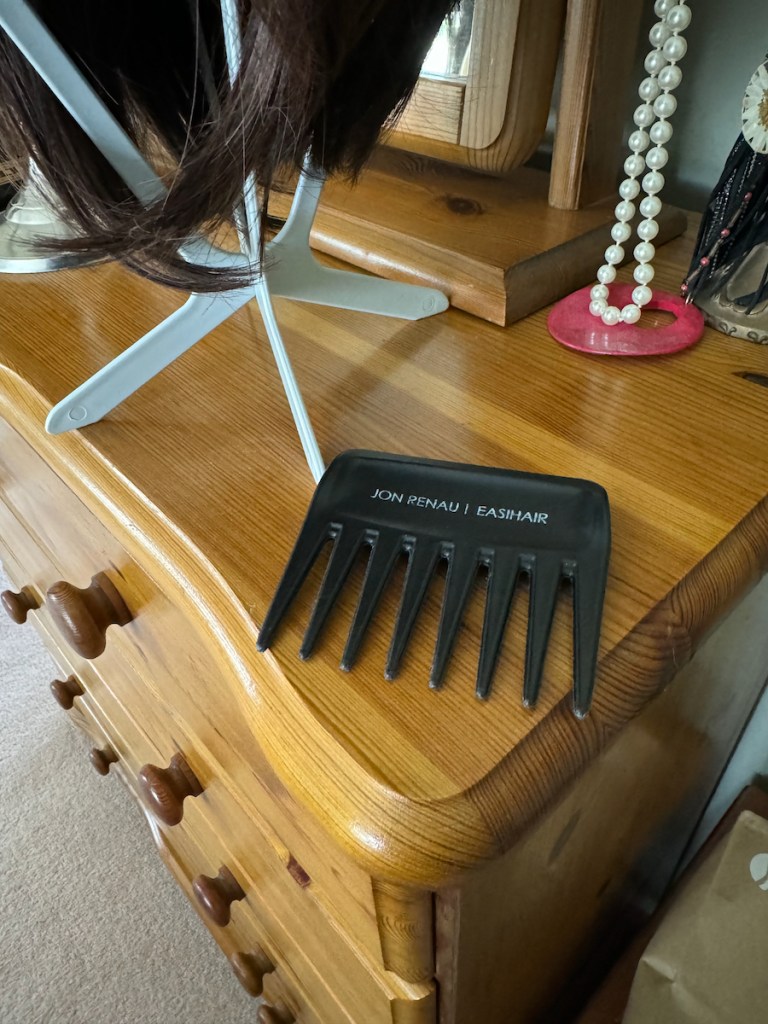
I wondered whether the wig was not sufficiently well made – it is a lightweight style, with fine fibres, and I wondered whether perhaps the knots were less secure too. However, being constrained by the need for a larger size wig, and the available colours and styles, I bought another 15 months ago, and vowed to spend some time looking into wig care in the hope of slowing the rate of shedding second time around. After some research, I came upon this wonderful comb by John Renau. It has broad teeth, unlike the stiff wires of my brush. Knots in synthetic hair are a bit weird – they tend to come apart quite easily if you work them gently with your fingers, but if you yank on them with a stiff brush, there is a tendency for the force to be transferred to the knot in the wig cap, starting the process by which it unties itself, or even to snap the fibre. However, the broad teeth of the John Renau comb mean that the natural tendency of the comb is to slip out of the hair when it meets resistance, rather than to get stuck and cause breakage. Of course, if you apply enough force, you’ll still cause damage. But the design of the comb works against this tendency. It hasn’t completely eliminated shedding for me, but it has reduced the rate markedly, with the consequence that I no longer worry about imminent baldness.
Another advantage of the broad teeth is that they’re much less likely to catch in the wig cap, in contrast to the wire brush bristles which have an annoying tendency to get caught, which can damage the construction of the cap.
So the problem was certainly not my wig, but the implements used to maintain it. An additional consequence of the damage caused by my wire brush was, ironically, that I became much more hesitant about brushing my wig, leading to an accumulation of knots close to the scalp. When I realised what had been happening, I spent quite a lot of time painstakingly and gently removing knots with my fingers. I did lose some hairs, even with the John Renau comb to help me, because there was such a lot of knotting close to the scalp, but once this was sorted out, maintenance became a lot more straightforward. Conditioner helps reduce knotting, but the advice is generally given not to apply conditioner near the wig cap, because it will tend to cause the knots to come undone. Gentle and very patient work with the fingers seems to help nearer the cap, but I certainly find that application of silicone (mineral oil) conditioner at the tip end of the fibres helps to reduce the tendency to knot.
The John Renau comb has certainly become my small obect of desire!
 Mrs Benn
Leave a comment