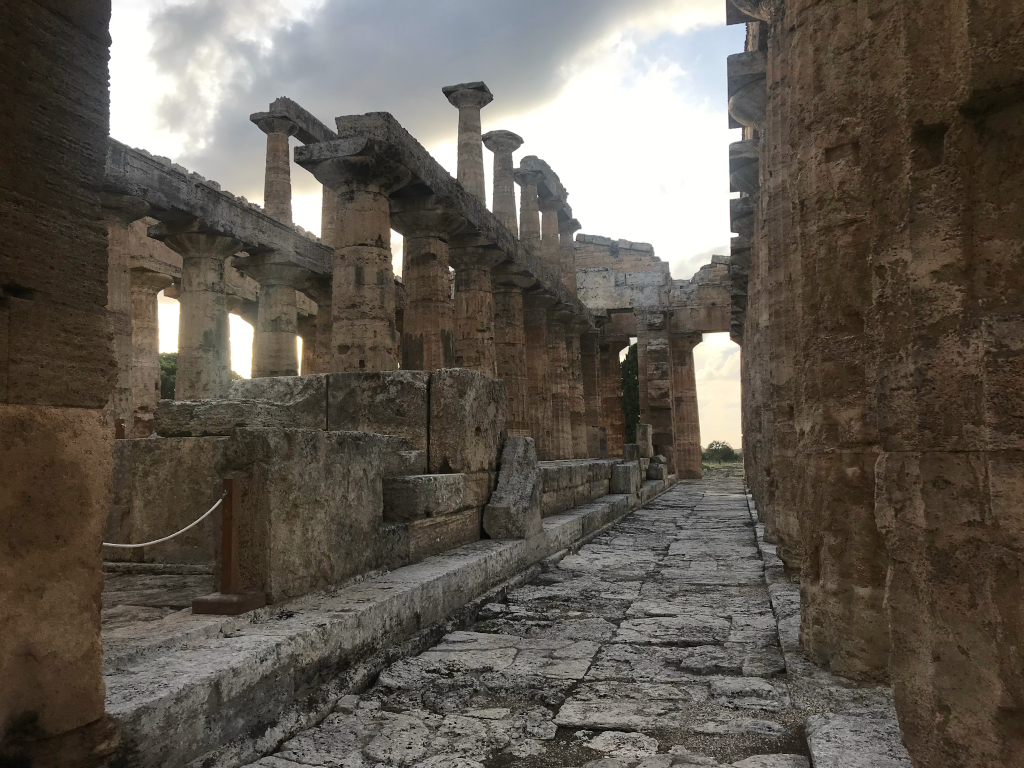
Temple of Neptune, Paestum, Italy.
It has long been an ambition of mine to visit Pompeii, ever since I studied Latin at comprehensive school. My school was formed by the amalgamation of two secondary modern schools and a girls’ grammar school. The secondary modern schools drew their pupils from areas with high levels of social disadvantage, and the new school quickly developed a rough reputation. By the time I arrived a few years later, the reputation was well established but the Latin teacher from the former girls’ grammar school remained. Thus, while attending one of the roughest schools in my home city I was able to learn Latin. I loved Latin for the logic of its linguistical structure, and for the opportunity of reading Pliny’s letters in their original language, revelling in the enigmatic and paradoxical picture he painted of the Romans: relaxing after sophisticated political intrigues, the construction of sewerage systems and public baths and experiments with glass and concrete making by watching men cut each other to pieces in the ampthitheatre. At school we learned Latin using the Cambridge Latin Course, unit 1 of which is entitled “Caecilius”. Through a series of short modules, we learned about a real person – Lucius Caecilius Iucundus – whose villa was uncovered in Pompeii. We were introduced to his wife, his children, his cook and to Cerberus, his dog. It was a fabulous way to bring a dead language to life.
In October I was invited to speak at a conference in Paestum, south of Naples. Paestum is a remarkable place in its own right, a major Greek city boasting three extraordinary and well-preserved temples constructed half a millenium before Pompeii was buried under volcanic ash, and its stunning temples would have provided incentive enough ceteris paribus. However, between Paestum and Naples lies Pompeii. This was surely an opportunity not to to be missed!
I booked a couple of days’ leave at the end of my conference to visit Pompeii and, while attending the conference in male mode, the remaining 5 days of my trip were mine and I decided to travel in female mode. This greatly simplified matters: it was much easier to keep my handbag, wig and breast forms with me and carry a slightly lighter suitcase containing my toiletries and changes of clothes.
Getting to Heathrow Airport proved to be a colossal challenge. A storm swept the UK, causing widespread flooding, and as I watched the National Rail live departures board, first one then another train to London was cancelled. I booked onto what looked like the only remaining train to London but when I arrived at the station, it has been cancelled. I looked at the possibility of catching a train from Doncaster to Kings Cross. A number had been cancelled but I found one that was running and booked a seat. I got myself to Doncaster, hauling my suitcase at speed up and down flights of steps – somehow without causing a relapse of my herniated disc. As the train pulled in, however, it was already packed, with standing room only and the promise of at least an hour’s delay in the journey. I did not believe my back would would withstand over three hours standing in a packed train, and wearily abandoned that plan. In desperation, I consulted Uber. A taxi to Heathrow was £370. I swallowed hard and requested a ride. However, even at this exorbitant rate, nobody could be found to drive me to London. In despair I boarded the next train to Sheffield, planning to abandon my journey, not realising that I didn’t have a valid ticket. As the train departed, the guard asked to see my ticket. I asked to buy one, and explained I’d been having a difficult day. The guard ushered me into his room at the end of the carriage. “Slip in here and I’ll sell you one”, he said. “We don’t want the inspector to see or you’ll get fined”, and he gestured a few rows down the carriage where an inspector was indeed making ticket checks. As he printed a ticket, I made a refererence to my complicated journey. “Have you thought of going via Stockport?” he asked. I hadn’t considered this, but his judgement was that trains from Manchester to Euston were starting to run normally again. He spent some time carefully checking movements of trains, and suggested catching the 19:11 to Stockport. Our train was due in to Sheffield at about that time, but he predicted that we would arrive a few minutes early. Almost every train to Stockport was cancelled, but the 19:11 was indeed running, and waiting for me as my train pulled into Sheffield. I managed to haul myself across the station in the nick of time. I boarded the 20:24 service from Stockport to Euston, which was virtually empty, and eventually, about 4 hours later than expected, I arrived at my hotel in London and checked in, suffering no more harm than shiny make-up.
The next morning I was up early to catch a flight to Naples. It was my first experience “flying pretty”, as my American friends call it, in Europe, although I once flew from Chicago to Denver in female mode. For trans folk, airports are awkward places. Those who have transitioned fully, have been awarded a gender recognition certificate (GRC) and have changed their names by deed poll have passports that match their presentation. However, for the rest of us, the process of airline travel can feel daunting because of the repeated checks of identity that bring a tremendous amount of awkwardness.
I am happy to say that my experiences at Heathrow Airport were very positive. Awkwardness was not completely eliminated, but to hope for this is probably incompatible with the fact that airport staff must make rigorous identity checks in order to keep passengers safe. I checked in at the Lufthansa desk, where a very courteous young man took a fair bit of time to compare me with the represtentation on my passport. He smiled kindly and reassuringly throughout, and did his very best to act as though what he was doing was nothing at all out of the ordinary. When persuaded that the person before him and the person in the passport photograph were one and the same, he wished me a happy flight and I was underway.
At security, the metal detector alarm went off. I was not wearing an underwired bra, and everything else metallic was in my bag, so I presume that this was a routine pat-down. I was asked by the young woman responsible to step into the body scanner. Aware that my breastforms might appear as anomalous, I decided to point this out to the security officer, on the basis that declaring it up front might save embarassment later. This turned out to be a good call, because she had clearly not scanned anybody like me before. There was a short moment of panic, after which she said “I’m going to have to ask my manager what to do”. Her manager came over, and reassured her that it was “not a problem at all”, saying that she should just carry out the scan and pat me down as normal. As I stepped out of the scanner, I could see my breastforms flagged as anomalies on the screen; thus, the decision to alert the officer up front was probably a good one. The security officer patted me down in much the sort of way that one might pat down an unexploded bomb, although with complete civility throughout. The embarassment associated with pointing out up front that I had breast prostheses was significantly less than I might have felt had the anomaly been flagged by the scanner, with the likely consequence that I would be left waiting while the inexperienced officer went to get help.
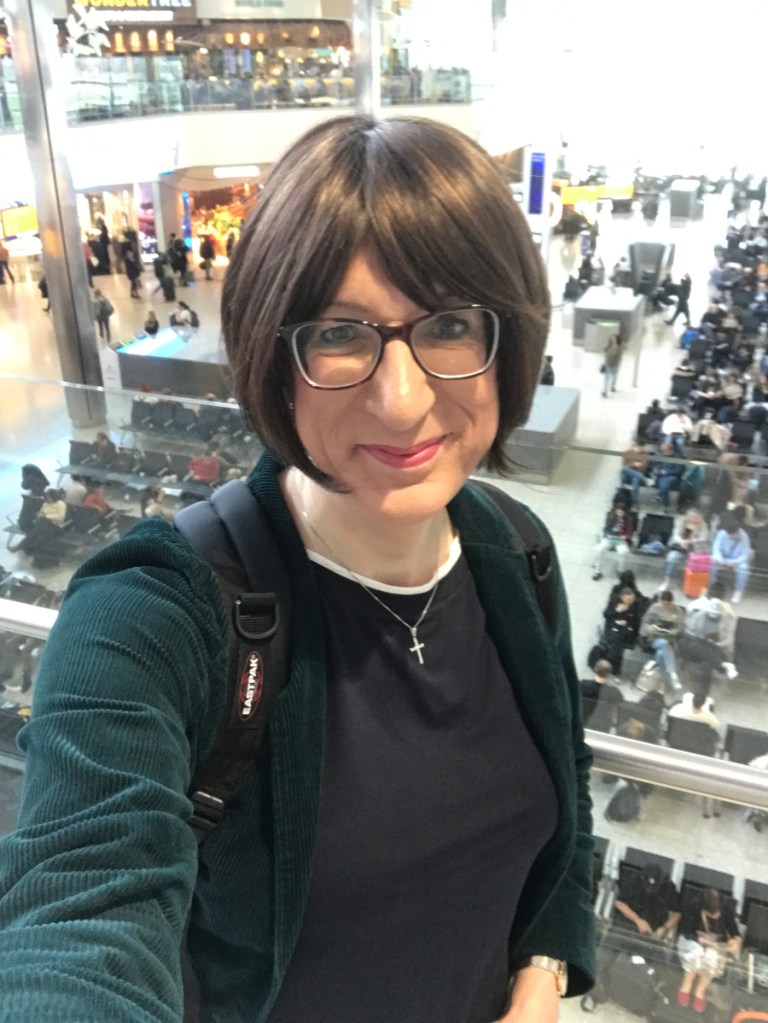
The photograph above was taken just after I left Security. Thereafter, everything became very normal; I disappeared into the crowds of other travellers. On board my flight, everything went very well, too. My seat was booked in my male name, of course, so that it matched my identity documents. However, there were no problems. I arrived in Munich, where I had to pass through border control. There, my passport was scrutinised by a severe young woman. Eventually, she asked me whether I was wearing a wig. Of course it is perfectly plausible that I had grown my hair out since the photograph in my passport was taken three years previously, and one might argue that the question was not necessary. However, it was perhaps a way to ask about my being trans without raising the matter explicitly. One has to be aware that the business of confirming identity underpins the prevention of crime and terrorism, so it is a serious matter. The border guard seemed to be very satisfied with my answer, and I was able to continue my journey. The worst hiccup was finding a spider – still moving albeit slowly – while halfway through a salad as I waited for my connecting flight. It was an experience entirely incompatible with all other experiences I have had in gleaming German airports!
In Italy, I passed quickly through passport control to await the arrival of my suitcase. In my carry-on bag (a small rucksack) I had packed a set of male clothes and some shoes, just in case my suitcase was delayed (its happened a few times over the years). However, on this occasion there were no problems and I soon found myself in the ticket hall at Napoli Centrale, buying a ticket to Paestum.
My experiences as a trans traveller were very positive. I am sure that there is always the possibility for hiccups. However, my experiences provided clear evidence that staff are well trained to deal with “anomalies” such as those presented by trans travellers. I was treated respectfully and with dignity. I am left once again feeling profoundly grateful for the transformation in attitudes that we have seen in society during my lifetime.
 Mrs Benn
Leave a comment